Archive for the 'Adsense' Category

Adsense Tip: Double Your CPC by Checking Blog Post Keywords

Here’s a tip for all the bloggers out there trying to monetize their blogs with Adsense:

When you are writing a blog post, write yourself a first draft. Work on it until you are happy with what it says, but don’t publish it yet. When you are done your first draft, open the External Adwords Keyword Tool. Copy the text of your drafted post into the keyword box, ensure that the ‘Use Synonyms’ box is checked, and hit ‘Get More Keywords’. Set the ‘Choose Data To Display:’ drop-down box to show ‘Cost and position estimates’, select USD from the currency box, and set a max CPC of $10.

Now click the column header which says ‘Estimated Avg. CPC’. This will sort all the CPC values for the keywords into descending order. What you will now have is a list of high-paying synonyms to a variety of the phrases within your article. Substitute the phrases you would like to use from the Adwords tool into your draft post as necessary.

You will find that a lot of the phrases that you used had higher paying variations compared to your original draft version, while still conveying the same information. If you do this consistently as part of your blogging habits, you will see your blog’s CPC and Adsense revenues as much as doubling.

Why I Will Try Not To Talk About Google’s Advertising System

Grr… if there is one shortcoming with Google’s PPC advertising system, it’s that whenever you mention it by name, and ads by the aforementioned advertising system running on my homepage all jump over to spammy tutorials, ebooks etc. on how to get rich by using it.

The net is so flooded with these ads, such as ‘How to get rich using ‘ or similar, that I bet these ads don’t even get a decent clickthrough at any rate. Perhaps it’s irrational, but I want to try to avoid them. Therefore, I am seeing how long I can go without speaking ‘the name I will not say’.

In the meantime, does anyone know of any way to set negative keyword for your adsense? If that feature is available, I do not know about it. If it is not available, perhaps Google’s PPC system team might consider implementing it…

P.S. yes, I know… I filed it under ‘that’ category…..

Big Search Engine Pissing Contest

Yesterday, I read an interesting post by Jeremey Zawodny in which he calls out Google for blatantly stealing Yahoo’s template for the IE7 download page and using it for their own, after changing a few branding marks.

Late last night/early this morning Matt Cutts posted an (un)official response to Jeremy’s accusation, apologizing to the Yahoo UI designer whose template was stolen:

I can only speak for me personally on this. If Jeremy looked into it and says that it wasn’t a template from Microsoft, I believe him. That would mean that the Yahoo! page was used as a template for Google’s IE7 promo page. I can’t say why someone at Google would decide to do that, but to the Yahoo! UI designer whose page was copied: my apologies. In my personal opinion, it sucks when someone else copies a page layout without attribution.

Matt quickly followed this up with a few comments and pictures pointing out how he imagines Google can sympathize with the designer seeing as how every move Google has made with regards to the design and formatting of their PPC ads was quickly copied by Yahoo (in addition to other PPC companies, I’m sure).

At the very end of his post, Matt offered this challenge:

Yup, getting copied without credit can suck. I’m glad that Jeremy was so observant and pointed this out immediately. Google has already changed the page, but I trust Yahoo will be on the lookout for copying in the future. ;)

This puts Yahoo in an interesting position - step up and admit that many of the ‘innovations’ they have applied to their PPC system were merely take from Google, or else sit down, pretend they didn’t see it, and drop the whole copying issue.

Good stuff - I love seeing point/counterpoint happen like that.

Google Confirms a 2% Click Fraud Rate

Just in case you haven’t read it yet, I would urge you to check out Andy Beal’s recent post Exclusive: Google’s Click Fraud Rate is Less than 2%.

Andy describes a sit down he had with Google’s business product manager for trust and safety, Shuman Ghosemajumder, in which Ghosemajumder shows him an internal presentation describing Google’s click fraud practice.If what Google says is true, than the only fraud going on may be on the part of the ‘click fraud companies’ that have popped up since the Lane’s Gifts vs. Google class action suit this year. If nothing else, even if the rate is higher than the 2% that Google claims it is, I have no doubt it still has to be *very* well below the 20-30% claimed by self-titled ‘click fraud analysts’.

On the other hand, these numbers are directly from Google; this may just be spin to try to reassure their advertisers. What I would really like to see is Google hiring on a responsible third-party company or individual to audit the Google click fraud monitoring procedures. That may be the only way we can see the real numbers.

What do you think?

Split Test Your Content as Well!

A lot of webmasters talk about split-testing their ad layouts, trying to determine which layout or block position gives a higher CTR. Well, perhaps you should take it a step further.

I had a page on one of my older sites which targetted a fairly well-paying aspect of the site’s niche. I was making on average about $0.20 per click on this page, which wasn’t bad; most of the pages on the site have consistently been paying in the range of $0.05-$0.10 per click.

This week, I had a writer rewrite the page. The new version was slightly longer, but had a different feel and phrasing than the original. I updated the page with the new content late last night. This evening, roughly 24 hours after posting the new version, the page was delivering me an average $1.35 per click, nearly 7x the average I was previously getting.

It may be to early to completely rule out the possibility of today just being a fluke, but I suspect that the slightly different phrasing used when the page was re-written triggered different ads than the previous version. Perhaps a word was used in the new version that was not in the previous version. Perhaps a certain phrase came together which never appeared previously. I don’t know.

No matter what you pay per article, I would suggest that it is definately worth writing two versions of an article or page, and split test the content to determine which version gives you the best CPC. Even if you pay $25 per article, the difference will eventually be made up.

In Other News, Shoemoney Gets His Adsense Account Banned….

update - This is a case of Shoemoney getting massively misquoted in the press. Please see his response at http://www.shoemoney.com/2006/12/07/forbes-article/. I apologize for any defamation or damage to the branding this article may have had!

Shoemoney is going to get his account taken away. Here’s why.

If you have been paying attention to the Search blogs lately, you will have heard about the Forbes.com article on PPC arbitrage in which both Jeremy ‘Shoemoney’ Schoemaker and Michael ‘Graywolf’ Gray are both quoted. Now, I haven’t read the article itself yet, but I just came across this extract which Andy Beal posted to his blog:

Schoemaker insists he and others have in fact found a way to circumvent the crackdown. He says he uses techniques like “cloaking” to fool Google’s algorithm. Arbitrageurs know the search engine’s IP addresses, the fingerprints that reveal the source of any Web page visitor. So Schoemaker says he sets his web pages to automatically display legitimate content to the Google spider, while giving other users the ad-filled arbitrage page. Schoemaker says that makes him virtually immune to Google’s quality-regulation measures.

… Since then, he says he’s made more than $2 million by arbitraging search terms related to cell phone ringtones, teeth whitening and mortgages. “I love Google,” Schoemaker says. “They changed my life.”

So here Shoemoney is, admitting on a national-level that he utilizes cloaking to bypass Google’s crackdown on PPC arbitrage. This is in violation of the AdSense Terms of Service where it says:

Do not employ cloaking or sneaky redirects.

If Google is really serious about cracking down on PPC arbitrageurs, they will have to ban Shoemoney. For him to announce to the world that he has, does, and will continue to effectively cheat the Adsense program by violating their TOS is a major blow to Google’s reliability. After all, $2 million is a lot to take out of advertiser’s pockets.

What do you think?

Typo Squatter loses Thousands of Dollars Due to Missed Details

Update: the mystery is finally solved

Setting

This yesterday, I mistyped the URL as I was visiting Google this morning; I accidentally typed http://www.google.cm. This redirected me to a page on the domain of http://www.agoga.com, which actually looked like a somewhat convincing, spartan page, very similar in style to what you would often see if your browser. Except that it also contained a search bar, and a few unobtrusive links to subject like ‘Travel’, ‘Cars’ etc., the kind of subjects you would see on a typical parked domain page.

Google.cm

I thought that was kind of interesting, a way of monetizing typos that looked to me at least like it would be somewhat effective way of squatting a typo. At the time, though, it didn’t seem noteworthy enough to me to give it further thought.

A little later, I was trying to get to Paypal, and again I accidentally typed http://www.paypal.cm. Once again I was at the same page. I was intrigued, and began experimenting by checking a variety of other domains with the .cm extension. Many big names in the industry had the .cm TLD pointed to the same page I had viewed earlier.

That also, is not that notable. A squatter could easily have registered a whole variety of company names in that TLD - it’s done all the time, and is considered a valid tactic for making some money off of parked domains.

What made it notable finally is when I started entering random domains, and sequences of characters in the .cm TLD. such as http://sdfjhksd.cm and http://www.oiyt.cm. These also are pointing to a landing page on agoga.com, albeit a different landing page from the ones used on major domain mispellings.

Agoga.com has every unregistered .cm TLD pointed to their landing pages!

While there are a bunch of legitimately registered .cm sites which resolve elsewhere, any other .cm domain, whether nonsense characters or misspellings of ‘real’ domain names resolves to the same IP address which is a cluster at agoga.com. The only way this could be accomplished is to change the default site settings of the master DNS serving the .cm TLD. Agoga must have either hacked the .cm registrar in Cameroon, or paid the registrar off for this. Either way, I suspect something illegal has occurred here; I doubt this type of redirecting is approved by IANA.
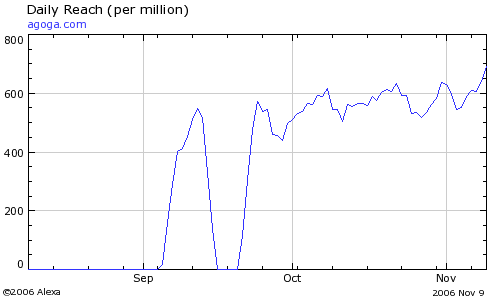
Agoga Alexa Graph

Opportunity

How much type-in traffic would you think would be generated by people misspelling .com as .cm? Agoga.com has an Alexa Rank of 6,915 which indicates thousands or tens of thousands of visitors per day by some estimates. Keep in mind that this site has not been running for even three months yet; today’s Alexa rank was 2,913.

Since Alexa ranking is biased towards a technical crowd, I think it is safe to assume that the true numbers are fairly large. Now, it is easily attainable that a proper landing page optimized for Pay-Per-Click advertisements will result in a 30%-40% click-through-rate. Especially if one was to put some effort into ensuring the advertisements were targeted around the domain name or keywords at the similar .com page.

It is obvious that with this type of traffic, Agoga.com could be pulling in some huge advertising revenue - as much a $1000-$2000 per day. They should have it made in the shade, for all intents and purposes. But, they have screwed up royally.

How did they screw up?

Agoga will return you to one of two landing pages, depending on what type of domain you enter. One version, which they seem to use when squatting the domain of a large company or popular website, can be seen at http://www.google.cm. The other, which they seem to use for the domains of smaller websites and nonsense or misspelled domains can be seen at http://www.oeiurt.cm (note the random domain name…) or http://www.caydel.cm (a typo of this domain) or at the Agoga main page at http://www.agoga.com.

The first type of landing page is broken - The first type of landing page is relatively well done - it is minimal, and could easily get the user to click onto their main site. The problem lies in that no ads are served if the user enters certain search queries. While an advertising page is shown if the user enters a query such as ‘digital cameras’, ‘dvd’, ‘knitting’, other queries such as ‘infohatter’, ‘caydel’ or whatever return nothing. Sure, probably nobody is bidding on that term; wouldn’t it be a better plan to grab the first result from a Google query for that term, scrape it for keywords, and return ads based on that? Potentially millions of long-tail opportunities are being missed here, thrown away for no good reason.

The second type of landing page broken - The script that Agoga used to generate the second style of landing page is broken. Any search query or link click redirects you to the same page you just left, with a nice photo of a mountain range, or other scenery visible in place of the advertisements that should be shown. They are making nothing from this type of landing page; in fact, they are losing money due to bandwidth costs.

Opportunity Missed

I would be willing to bet that the majority of the traffic that Agoga.com receives will end up at the second landing page, the broken one. While they probably have their highest traffic domains such as http://www.google.cm pointing to their ‘working’ script, they are missing out on the whole long-tail of domain misspellings. Think about it this way - any mistake made by anyone anywhere when he misspells .com as .cm will send him to the broken script. This could be anyone typing in one of a billion domains.

Additionally, a fair number of people who misspell the the domains of large sites such as Google will make multiple mistakes - they may mispell google.com as google.cm, but how many are prone to make multiple mistakes such as gogle.cm or googel.cm and be sent to the broken page?

What Are You Trying to Tell Us Here?

The point of what I am trying to say should have become clear by this point, but I will write it out nice and neat anyways: an neglect of details can lose you a lot of money. I do not know if this second landing page has ever actually worked for Agoga. Perhaps it has, and only stopped working 15 minutes before I stumbled upon it the first time. Perhaps it has never worked. The fact of the matter is, the person or persons who own Agoga.com (Whois data indicates Nameview, Inc, BTW) are losing thousands of dollars per day. It is probably safe to assume that they don’t even realize this; if they did, they would fix it in realtively short order.
The people responsible for this had an amazing idea, which they ran with 90% of the way to the perfect money-making opportunity. But they have missed a few small details which are costing them perhaps thousands of dollars per day. If they were to fix these small problems, they could probably nearly double their income.

I appreciate your comments and feedback!

« Previous PageNext Page »